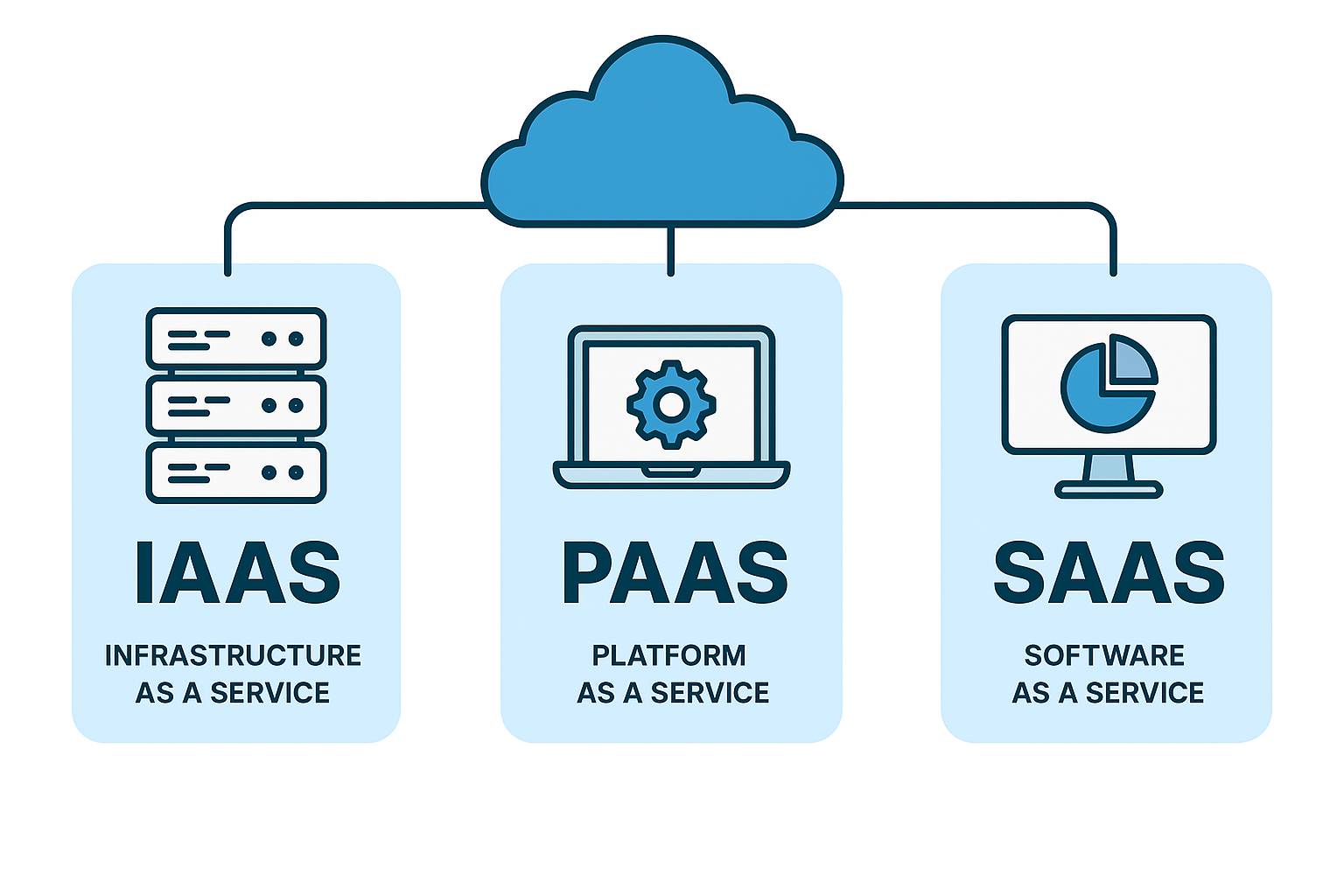
Cloud computing delivers IT services over the internet, and its three main models ” IaaS, PaaS, and SaaS” offer different levels of control, flexibility, and management. Understanding these models helps individuals and businesses choose the right solution for their needs.
What Is Cloud Computing?
Cloud computing allows users to access computing resources, like servers, storage, databases, and software, on-demand via the internet, without owning physical infrastructure. Instead of buying and maintaining hardware, users rent resources from cloud providers like AWS, Microsoft Azure, or Google Cloud.
The Three Main Cloud Service Model
1. IaaS – Infrastructure as a Service
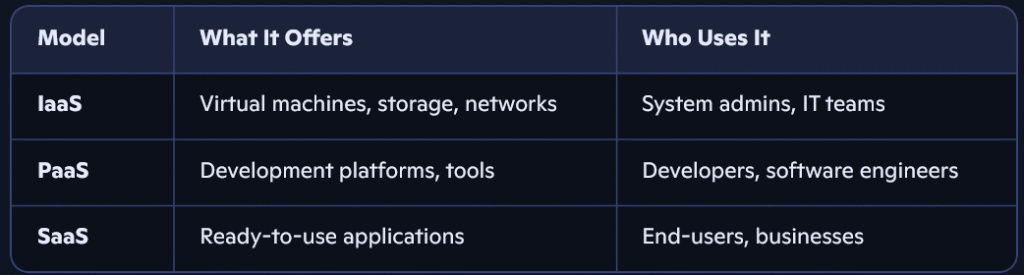
- What it is: Provides virtualized computing resources over the internet.
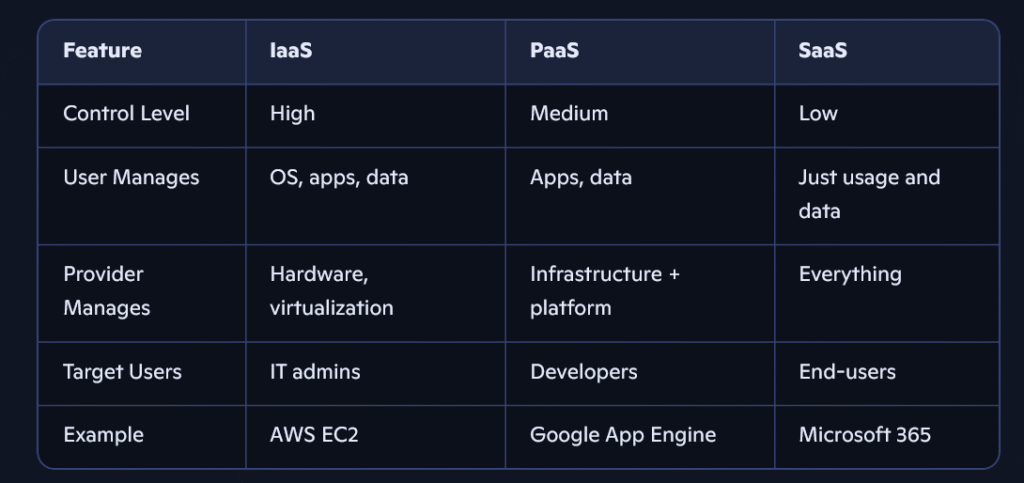
- You manage: Operating systems, applications, data.
- Provider manages: Servers, storage, networking, virtualization.
- Use case: Hosting websites, building custom applications, data storage.
- Examples: Amazon EC2, Microsoft Azure Virtual Machines, Google Compute Engine.
Benefits:
- High flexibility and scalability.
- Pay-as-you-go pricing.
- Ideal for system administrators and IT teams.
- PaaS – Platform as a Service
- What it is: Offers a platform with tools to develop, test, and deploy applications.
- You manage: Applications and data.
- Provider manages: Runtime, middleware, OS, servers, storage, networking.
- Use case: App development without worrying about infrastructure.
- Examples: Google App Engine, Heroku, AWS Elastic Beanstalk.
Benefits: - Speeds up development.
- Reduces infrastructure complexity.
- Ideal for developers and software teams.
3. SaaS – Software as a Service
- What it is: Delivers software applications over the internet.
- You manage: Just your usage and data.
- Provider manages: Everything else (app, platform, infrastructure).
- Use case: Email, CRM, collaboration tools.
- Examples: Google Workspace, Microsoft 365, Salesforce, Zoom.
Benefits:
- No installation or maintenance.
- Accessible from any device with internet.
- Ideal for end-users and businesses needing ready-to-use tools.
Choosing the Right Model
- if you need full control over your environment and want to build from the ground up USE IASS
- if you’re focused on developing applications and want to avoid infrastructure headaches USE PASS
- if you need ready-to-use software with minimal setup USE SASS
Core Concepts of Cloud Computing
The core concepts of cloud computing revolve around virtualization, scalability, on-demand access, and service models like IaaS, PaaS, and SaaS. These principles anchor the cloud’s ability to deliver flexible, efficient, and cost-effective IT resources over the internet.
1. Virtualization
- Definition: The foundation of cloud computing. It allows multiple virtual machines (VMs) to run on a single physical server.
- Tools: Hypervisors like VMware, Hyper-V, and KVM.
- Impact: Enables resource sharing, isolation, and efficient hardware utilization.
2. On-Demand Self-Service
- Users can provision resources (e.g., servers, storage) without human interaction from the provider.
- Benefit: Rapid deployment and scalability without delays.
3. Scalability and Elasticity
- Scalability: Ability to increase resources to meet growing demand.
- Elasticity: Automatically adjust resources up or down based on real-time needs.
- Example: Auto-scaling groups in AWS.
4. Resource Pooling
- Multi-tenancy: Resources are shared among multiple users while maintaining data isolation.
- Efficiency: Maximizes utilization and reduces costs.
5. Measured Service (Pay-as-You-Go)
- Billing is based on usage—compute power, storage, bandwidth.
- Transparency: Users can monitor and control their consumption.
6. Broad Network Access
- Access from anywhere using standard devices (laptops, phones).
- Cloud services are platform-independent, accessible via the internet.
Anchors to the Cloud: Service Model
Cloud computing is transforming how businesses operate by offering scalable, cost-effective, and flexible solutions. Whether you’re building apps, managing infrastructure, or just using software, understanding IaaS, PaaS, and SaaS is key to making smart technology decisions and more life easier.