Programming languages are structured systems of communication that allow humans to instruct computers to perform tasks. They are essential for building software, automating processes, analyzing data, and powering digital experiences.
🧠 What Is a Programming Language?
A programming language is a formal language comprising a set of instructions that produce various kinds of output. These instructions are written using specific syntax and semantics that a computer can interpret and execute.
- Syntax: The rules that define how code must be written (like grammar in human languages).
- Semantics: The meaning behind the syntax — what the instructions actually do.
- Compiler/Interpreter: Translates human-readable code into machine code (binary) that the computer understands.
Programming languages bridge the gap between human logic and machine execution, enabling developers to build everything from simple scripts to complex systems.
🧰 What Are Programming Languages Used For?
Programming languages serve a wide variety of purposes across industries and domains:
1. Web Development
- Languages: HTML, CSS, JavaScript, PHP, Python
- Use: Building websites, web apps, and interactive user interfaces
2. Software Development
- Languages: Java, C++, C#, Python
- Use: Creating desktop applications, mobile apps, and enterprise software
3. Data Science & Machine Learning
- Languages: Python, R, Julia
- Use: Analyzing data, building predictive models, training AI systems
4. Game Development
- Languages: C++, C#, Lua
- Use: Designing and programming video games and simulations
5. Systems Programming
- Languages: C, Rust, Assembly
- Use: Developing operating systems, device drivers, and embedded systems
6. Automation & Scripting
- Languages: Python, Bash, PowerShell
- Use: Automating repetitive tasks, managing servers, and scripting workflows
7. Database Management
- Languages: SQL
- Use: Querying, updating, and managing relational databases
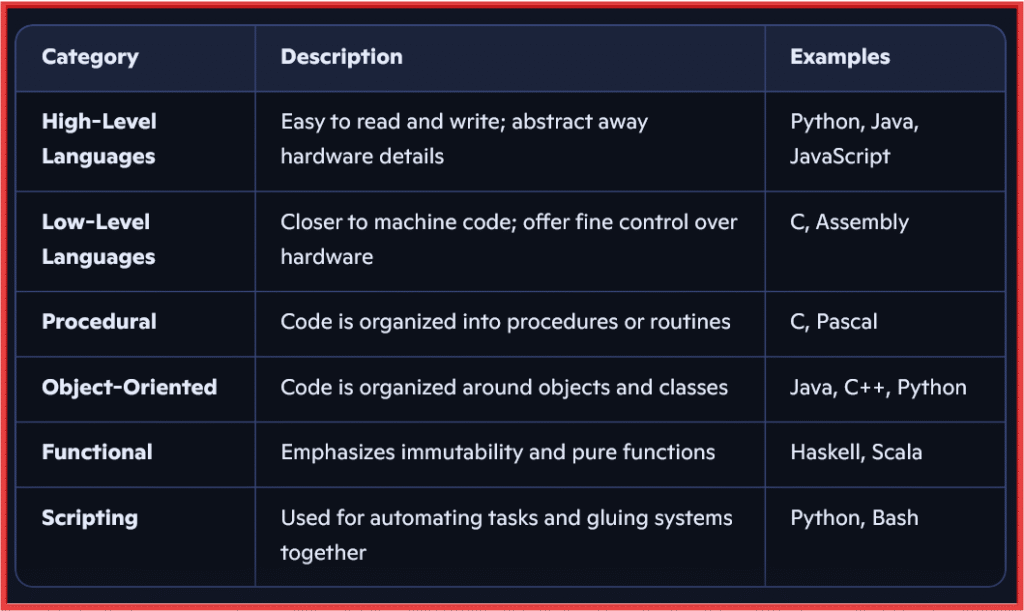
🧰 Types of Programming Languages
Programming languages can be categorized based on their abstraction level and paradigm:
🚀 Why Understanding Programming Languages Matters
- Problem Solving: Enables logical thinking and structured problem-solving.
- Career Opportunities: Opens doors in tech, finance, healthcare, and more.
- Innovation: Powers the creation of new tools, apps, and digital experiences.
- Efficiency: Automates tasks and improves productivity across industries